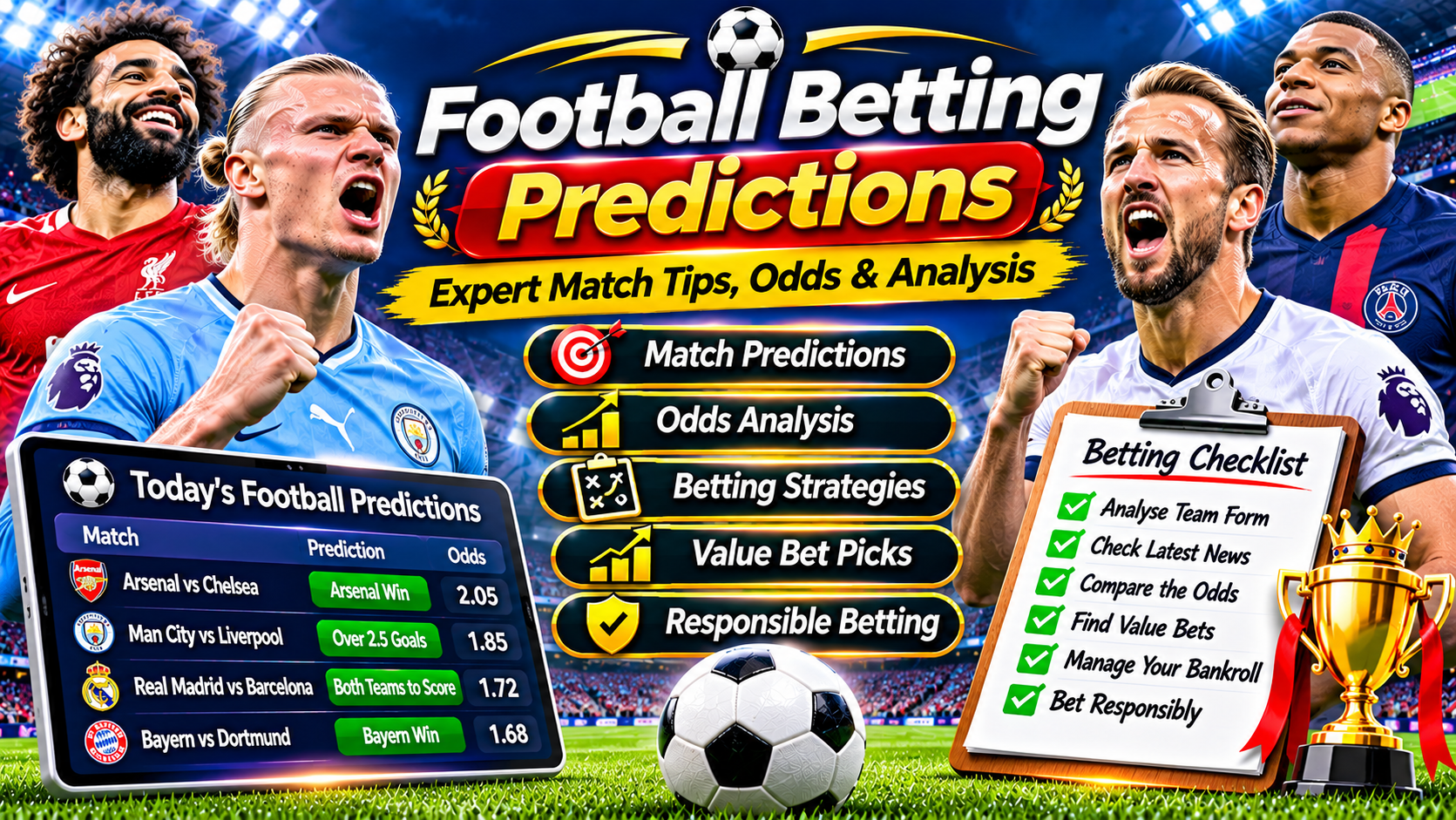
How to Use Predictions Before You Place Any Bet
Before you look at odds, decide whether you’re building a multi-bet slip or making single bets with Football Betting Predictions a clear thesis. A buyer-intent approach means you treat each selection like a product you’re evaluating, not a guess you hope wins. That mindset helps you avoid impulsive bets and makes your process repeatable.
Next, translate any prediction into a concrete market choice. For example, if you believe a team controls possession and creates chances, a team total or over-market may align better than a straight win bet. If you expect a cagey match with limited scoring, under markets and both-teams-to-score alternatives can reflect that expectation. Even strong analysis can be wasted if it’s placed in a market that doesn’t match how the game is likely to unfold.
Finally, compare your reasoning to the market’s pricing. Odds are not just numbers; they summarize what many bettors already believe. If your view suggests the price is too low or too high, you may have a value angle worth exploring. If your view merely agrees with the consensus, you should be more selective and consider smaller stakes.
For a buyer-intent guide, you also want a simple checklist you can use every time. Identify injuries, confirm tactical setups, and check recent goal patterns with context like opponent strength. Then look at referee tendencies for cards and possible stoppages that affect momentum. When your checklist is consistent, you’ll make fewer emotional decisions and more evidence-based ones.
Match Preview Framework: Form, Tactics, and Lineups
A reliable match preview begins with team form, but not in a shallow “results only” way. Look at how the team wins and loses: clean sheets versus high-scoring defeats, narrow wins versus comfortable control, and whether scoring trends match underlying chances. Then evaluate opponent form through matchup lenses, such as defensive shape against specific attacking styles. This is where many bettors miss value, because raw standings don’t explain how chances are created.
Lineups and role clarity are another major factor for practical betting decisions. A forward who starts consistently can change the probability of shots on target, while a midfield absence can reduce build-up tempo. Pay attention to whether a team plays with a high line or stays compact, because that impacts offside frequency and transition chances. Even small tactical tweaks can move goal markets significantly, especially in leagues where margins are tight.
To make your buyer-intent process more actionable, map the match into likely game scripts. For instance, if one side is expected to press early, they may force turnovers that lead to faster scoring. If the favorite usually wins by breaking down low blocks, both-teams-to-score markets may behave differently than matchups where the underdog can counter. When you have a game script, you can choose markets that align with that script instead of chasing outcomes.
Don’t ignore situational angles either. Home-field advantage can influence tempo and risk-taking, and travel fatigue can affect late-game intensity. Cup rotations can also shift player usage, which may reduce attacking output even if the starting XI still looks strong on paper. By combining form, tactics, and lineup realities, you reduce uncertainty and place bets that match how the match is expected to play.
Odds, Goal Markets, and Value Traps to Avoid
Implied probability can reveal whether the market is pricing in injuries, tactical changes, or public sentiment. If your chance of a specific outcome is meaningfully higher than the implied probability, you’ve found a potential value spot. If it’s lower, even a tempting narrative may be a value trap.
Goal markets often provide cleaner signals than many outcome markets. Over/under selections can reflect how teams generate chances and how often they concede, while both-teams-to-score can capture match script balance. If one team struggles to finish chances against compact defenses, overs may be less reliable even if they dominate possession. Likewise, unders can fail when one side tends to concede quickly after scoring or when defensive errors are frequent.
Be careful with “popular” bets that look safe but are overpriced. Markets that depend on a single event—like a team scoring first or a last-minute winner—often carry hidden variance. The same logic applies to heavy favorites in volatile leagues, where a single red card or tactical mismatch can flip the game. Instead of chasing the biggest favorite, consider markets that reflect the underlying styles more directly, such as shots-focused patterns translated into goal expectations.
Liquidity and odds movement also matter. If odds shorten rapidly right before kickoff, it may indicate sharp money or a late injury update. If odds drift, it may reveal that initial information was incorrect or that market sentiment has cooled. A buyer-intent approach means you track movement briefly and align it with credible news, rather than reacting to every tick without context.
Responsible Betting: Stake Sizing and Risk Limits That Work
Even the best analysis can’t guarantee profit, so responsible betting is essential for staying in control. Decide a maximum stake you can lose without affecting your normal budget, and use that as a strict rule. Many bettors fail by increasing stakes after losses, which turns variance into a long-term disadvantage. When your process includes defined limits, you can keep placing bets only when the edge is strong.
Consider splitting your risk across different bet types instead of stacking everything into one slip. If you’re confident in a goal expectation, you might use a conservative over or under line rather than an extreme target. If you like both teams scoring, check whether the matchup supports that script instead of placing it automatically. Diversification doesn’t eliminate risk, but it can reduce the impact of one wrong assumption.
Use “confidence tiers” to decide what you place. A higher-confidence thesis might justify a single-market bet, while a lower-confidence thesis should be smaller or replaced with a steadier market. For example, you may feel good about a team’s attacking output but less certain about clean-sheet prospects, so you might avoid double-sided markets. This keeps your bets consistent with your actual conviction rather than your emotions.
Finally, set review habits. After match results, evaluate whether your reasoning was correct in process terms, not just outcome terms. Did the starting lineup reflect the assumptions you made? Did the tactical script resemble what you expected? When you learn from each bet, you improve your future selection quality and reduce repeating the same mistakes. Responsible betting is also about learning quickly while minimizing harm.
Conclusion
By using a repeatable framework—form with context, tactical fit, confirmed lineups, and odds-aware value checks—you make your decisions more disciplined. Goal markets can be especially useful when you connect them to a realistic game script. When those elements align, your bets are more likely to reflect the true probabilities of the match. Responsible betting completes the system. Set strict stake limits, avoid chasing losses, and choose bet structures that reflect your confidence level. Track odds movement briefly in line with credible news, and be alert to value traps that look safe but carry hidden variance. With consistent process and controlled risk, you can turn predictions into a practical approach that supports long-term decision quality.